
Ever stared at a water filter’s digital screen and noticed a number labeled “TDS”? If you’re anything like me, your first instinct was to ignore it. Then curiosity hit. And next thing you know, you’re deep into water science, realizing that little number holds a whole lot of meaning for your glass of water.
Let’s break it down — in a way that feels like a conversation, not a chemistry lecture.
It All Starts with a Definition
So, first things first — tds full form of water stands for Total Dissolved Solids. It’s not as scary as it sounds. Basically, it refers to the total amount of dissolved substances — both organic and inorganic — in your water. This includes minerals, salts, and even small amounts of metals.
Now, TDS isn’t necessarily bad. In fact, some dissolved minerals like calcium and magnesium are good for us. They can even give water a more “rounded” taste. But when the levels get too high — or if the wrong kinds of particles sneak in — that’s where trouble can start.
How Do You Measure It?
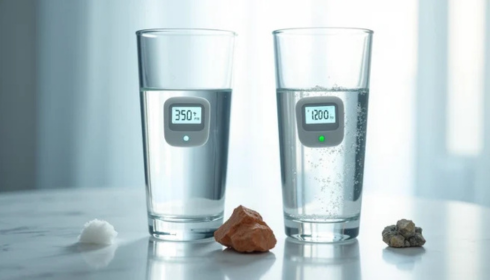
Here’s where things get hands-on. One of the easiest ways to find out your TDS is with a water test TDS meter — a small, pen-like device you dip into your water. Within seconds, you get a number in parts per million (ppm). It’s strangely satisfying, kinda like checking your steps on a smartwatch. The lower the number, the purer the water — at least in theory.
For example:
- Distilled water: 0–10 ppm
- Reverse osmosis filtered water: 10–50 ppm
- Tap water: 100–400 ppm (depending on your area)
- Mineral water: Can go up to 500 ppm or more
But here’s the kicker: TDS tells you how much is in your water, not what. So, a high number could be harmless minerals… or a hint you need a plumber ASAP.
Why Should You Even Care?
Taste, for one. Ever notice how water tastes different in different cities? That’s TDS at work. High TDS can give water a heavier, sometimes even metallic taste. Low TDS can taste flat or “empty.”
And then there’s your appliances. Water with a lot of dissolved solids tends to be “hard.” That can lead to limescale buildup in kettles, coffee machines, and water heaters — not to mention itchy skin and flat hair if you’re showering with it.
More importantly, excessively high TDS might signal that your water has contaminants — which means it’s not just about taste or limescale. It’s about your health.
What’s Up With Tap Water?
Ah yes, tds tap water — probably the most inconsistent character in this whole story.
Depending on where you live, your tap water’s TDS can be anywhere from “totally fine” to “this explains the weird film on my dishes.” Municipal water providers usually stay within the EPA’s maximum contaminant level (500 ppm), but the makeup of those solids still matters.
Let’s say your tap water reads 350 ppm. Not horrible, but if those parts are mostly sodium, chlorine, or even trace metals, it’s something you’ll want to investigate further. On the flip side, some places have naturally mineral-rich tap water, which might taste great and be totally safe.
Still, it never hurts to test. Especially if you’re planning on installing a filtration system or just want better-tasting coffee.
Is Lower Always Better?
Not necessarily. Some people aim for the lowest TDS possible, especially those using reverse osmosis (RO) filters or distillation. But ultra-pure water can actually feel too clean — almost lifeless — and might even leach minerals from your body over long-term use.
Balance is key. Most experts agree that water with a TDS range between 100–300 ppm hits the sweet spot — it tastes good, feels right, and isn’t loaded with junk.
That said, if your TDS is too low or too high, it’s worth exploring why. Is your filter stripping everything out? Is your plumbing adding something it shouldn’t? That little number can lead to some big questions.
Final Thoughts: It’s Just a Number, But Not Just a Number
Here’s the thing — TDS won’t tell you everything. It won’t identify specific contaminants, and it certainly won’t replace a full water quality report. But it will give you a snapshot. A helpful starting point. Something to pay attention to, especially if you care about what’s in your glass.