
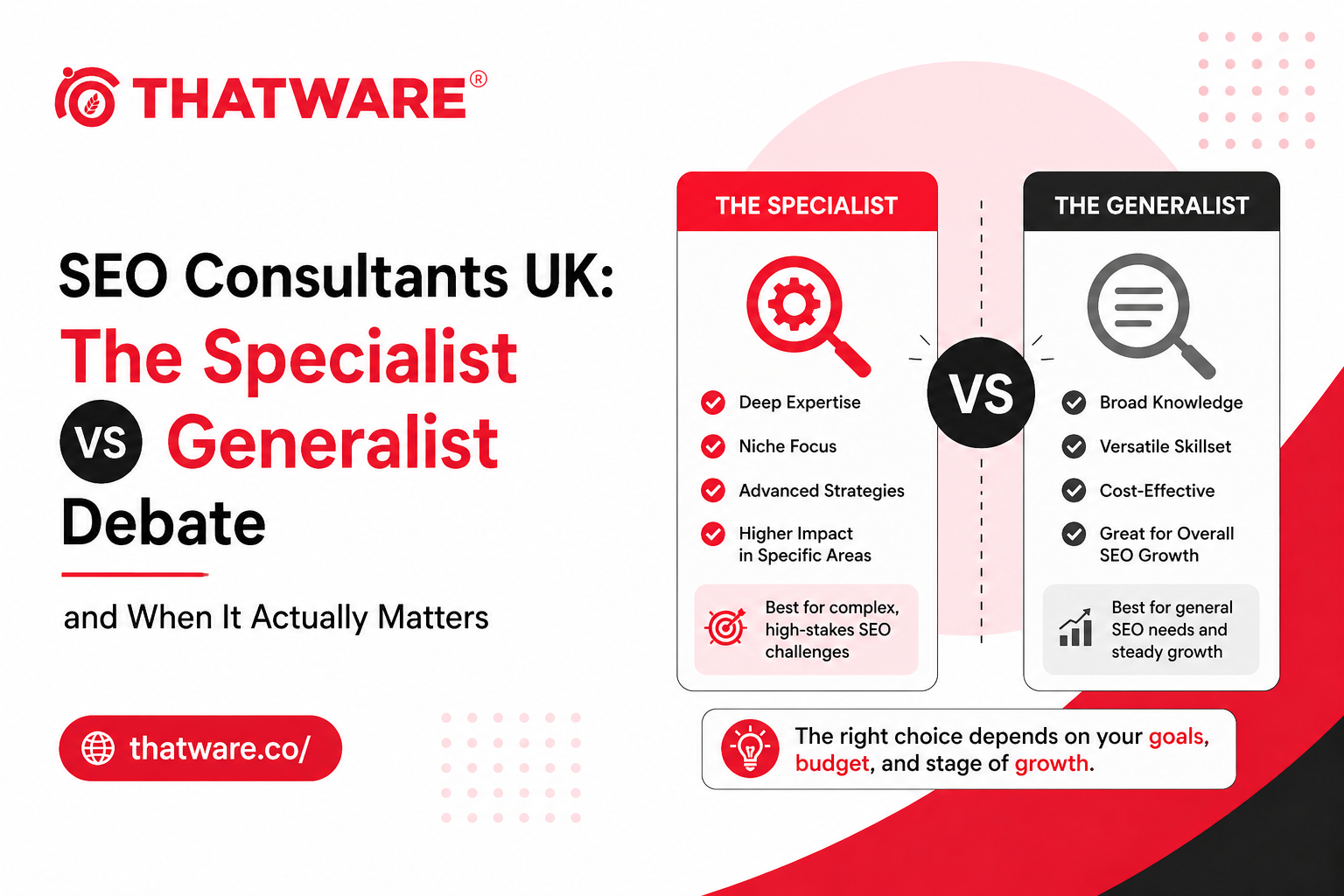
The debate between hiring an SEO specialist and a generalist has been running in marketing circles for years, and it rarely gets resolved cleanly because the honest answer is that it depends on specifics that the generic debate ignores.
In the UK SEO market specifically, both specialist and generalist practitioners are well-represented and both have genuine value in the right context. The question worth answering is which context favors which approach, so businesses can make the decision deliberately rather than by default.
What the Distinction Actually Means
A generalist SEO consultant or agency has broad capability across technical SEO, content strategy, link building, local SEO, international SEO, and analytics. They can handle most of what a website needs across all of these dimensions at a competent level. For most businesses, most of the time, this is what they need.
A specialist, in the SEO context, has deep expertise in a specific type of SEO work or a specific industry. Technical SEO specialists focus on crawl optimization, rendering, site architecture, and the engineering-adjacent work that generalist practitioners often handle at a surface level. Content strategy specialists build topical authority programs and content architectures. Industry specialists have deep familiarity with how search works in specific verticals like finance, healthcare, legal, or ecommerce.
The value difference is not that specialists are always better. It’s that their specific depth produces better outcomes than generalist capability in specific situations, and generalist breadth is more appropriate in others.
When Specialists Produce Better Outcomes
Large sites with complex technical issues are the clearest case for technical SEO specialization. A site with hundreds of thousands of pages, JavaScript rendering challenges, complex faceted navigation, and international versions in multiple languages is presenting problems that generalist practitioners often address incompletely. A technical SEO specialist who has spent years specifically on crawl optimization and rendering has solved these problems in enough different contexts to bring pattern recognition and depth that a generalist can’t match.
Regulated industries where content must navigate compliance constraints benefit from industry specialists.Uk seo consultants with deep experience in financial services, healthcare, or legal know the content constraints, the regulatory landscape, and the competitive dynamics of those verticals in ways that generalists working across industries don’t build up.
Competitive niches where content must demonstrate genuine domain expertise to rank effectively benefit from specialists or agencies that have built specific vertical expertise. Google’s quality evaluation for YMYL content, specifically Your Money Your Life categories including financial advice, medical information, and legal guidance, places particular weight on demonstrated expertise. A generalist without specific knowledge of your industry is less able to produce content that signals genuine expertise in these categories.
When Generalists Are the Better Choice
Most small to medium businesses with clear-cut SEO needs benefit more from a good generalist than from a specialist who excels at one dimension while leaving others underserved.
A local service business that needs Google Business Profile optimization, some content around its core services, basic technical health, and a few local citations doesn’t benefit from a deep technical SEO specialist who treats local optimization as a secondary concern. It benefits from someone who handles the whole picture competently.
Businesses in non-specialist industries where content doesn’t require deep domain expertise and technical complexity is manageable benefit from generalists who can move across all the levers that drive organic performance without the coverage gaps that specialization sometimes creates.
Early-stage businesses that are building their SEO foundation for the first time often need generalist guidance to understand what the whole picture looks like before deciding where to invest more deeply.
The UK Market Specifics
The UK SEO market is mature and relatively dense with capable practitioners, which is good for buyers. Competition keeps quality standards reasonably high and pricing competitive.
A few UK-specific factors are worth considering when evaluating consultants.
The UK’s regulated industries, particularly financial services, have specific FCA-related constraints on content claims that practitioners in those verticals need to understand. Financial services SEO in the UK requires specific compliance awareness that not all generalists carry.
Seo company uk providers with experience in UK retail know the competitive dynamics that matter, including the influence of comparison sites, voucher code sites, and price comparison platforms on SERP real estate in commercial categories.
UK local search has specific characteristics, including the influence of Yell, Trustpilot, and other UK-specific directories and review platforms that affect local visibility in ways that practitioners primarily experienced in US markets may not have depth in.
The Practical Evaluation
When you’re talking to UK SEO consultants, a few things help identify depth of specialization or generalist breadth quickly.
Ask which types of clients they tend to work with and why. Specialists usually have a clear answer that reveals their focus area. Generalists will describe a broader client range and explain why they’re comfortable across that range.
Ask what they’re not as strong at. Honest practitioners know their relative weaknesses, and this question reveals both honesty and self-awareness. Someone who claims equal strength in all areas is either unusually exceptional or not being fully candid.
Ask specifically about a challenge similar to yours and how they’d approach it. The specificity of the answer, how precisely they engage with your situation versus giving a generic answer about their methodology, is the most reliable indicator of relevant depth.
The right choice for your situation is out there. Being clear about what you actually need before starting the evaluation process makes finding it significantly more efficient.