
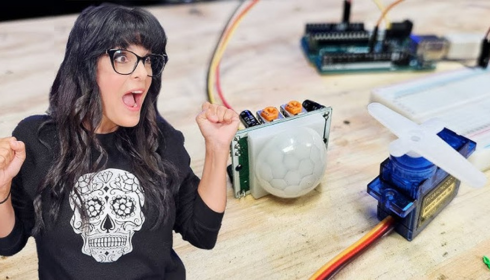
Introduction: Where Theory Meets Real Movement
Physics often feels abstract—formulas on paper, diagrams in notebooks—but the moment you build something that actually moves, it all starts to click. That’s why working on a physics project involving motion control can be incredibly satisfying. One of the most useful components for such projects is the servo motor, a device that translates electrical signals into precise mechanical movement.
Understanding the Basics of Servo Motors
A servo motor isn’t just another motor that spins continuously. It’s designed for controlled motion, meaning it can rotate to a specific angle and hold that position. Inside, it combines a motor, a control circuit, and a feedback system. This feedback loop ensures accuracy, which is why servo motors are widely used in robotics, automation, and even remote-controlled vehicles.
What makes it especially appealing for students is how predictable it is. You can tell it to rotate 30°, 90°, or 180°, and it will respond accordingly. This level of precision opens the door to many creative experiments and models.
Why Servo Motors Are Ideal for Physics Projects
When you’re building a project, you want components that demonstrate real-world principles clearly. servo motor are perfect for showing concepts like torque, angular motion, and control systems. Instead of just explaining how force causes rotation, you can actually show it in action.
For example, a simple project could involve a rotating arm controlled by a servo motor. By adjusting the input signal, you can observe how the arm moves and stops at different positions. This makes learning interactive rather than theoretical.
Applications You Can Try
There’s no shortage of ideas when it comes to using servo motors. One popular option is an automatic door system. When a sensor detects motion, the servo motor rotates to open the door and then returns it to its original position. This demonstrates both motion and automation in a single setup.
Another interesting idea is a solar tracking system. Here, the servo motor adjusts the angle of a solar panel based on the position of the sun. It’s a brilliant way to combine physics with environmental awareness and practical application.
Robotic arms are also a favorite among students. By using multiple servo motors, you can control different joints and create complex movements. It may sound advanced, but even a basic version can teach a lot about coordination and mechanics.
How It All Comes Together
The beauty of combining physics concepts with electronics lies in the connection between input and output. You provide an electrical signal, and the servo motor responds with motion. This direct cause-and-effect relationship helps reinforce fundamental physics ideas like energy conversion and mechanical work.
Typically, you’ll use a microcontroller such as Arduino to send signals to the servo motor. The code determines how much the motor rotates, and you can adjust it easily to test different scenarios. It’s a simple setup, but it offers endless possibilities for experimentation.
Challenges You Might Face
Like any hands-on project, there are a few hurdles. Power supply issues can affect performance, and incorrect wiring might prevent the motor from working altogether. Sometimes, the movement may not be as smooth as expected, which can lead to debugging and fine-tuning.
But honestly, that’s part of the learning process. Each small mistake teaches you something new, whether it’s about circuits, coding, or mechanical design.
Conclusion: Turning Ideas into Reality
At its core, a physics project is about understanding how the world works—and then proving it through action. When you incorporate a servo motor into your design, you move beyond theory and into real, observable results. It’s that moment when a simple idea starts to feel like an actual invention.
So whether you’re building a school model or exploring electronics as a hobby, combining physics concepts with servo motors can transform your learning experience. It’s hands-on, engaging, and just a little bit addictive—in the best way possible.